The end of it A genuine cast-iron machine for the price of a decent random orbit sander. The best value in the sanding group here.
Every figure is a manufacturer specification, read off the
listing itself, and the judgments are ours — drawn from how the
specification behaves in this class of machine and from what long-term
owners consistently report. Where a figure is missing, we say so rather
than fill it in.
What the specification says
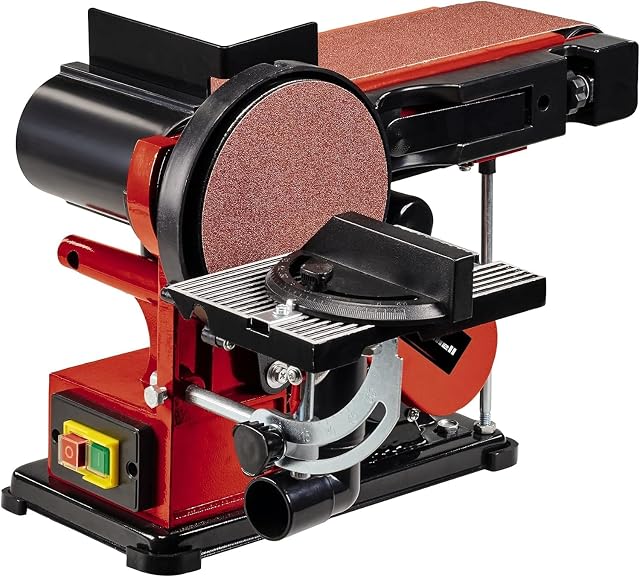
A 370 W induction motor described by Scheppach as low-noise, a Ø 150 mm (5.91 in) sanding
disc, a 915 × 100 mm (36 × 3.94 in) belt, a table that tilts from 0° to 45° against a scale,
and a belt arm that can be positioned anywhere from 0° to 90°, vertical or
horizontal. The housing is cast iron. Supplied with a mitre gauge, three belts,
three discs and an extraction adapter, and the discs are hook-and-loop backed.
Part number 5903306901.
Sanding dust is the fraction that matters
A saw makes chips you can see and sweep up. A sander makes particles
fine enough to hang in the air for hours after the machine is switched
off, and those are the ones that reach the deep lung. Hardwood dust is
classified as a carcinogen in the European Union, which is why every
machine in this class has an extraction port and why connecting it is
not an optional refinement.
The port is half the answer. Extraction at the tool catches most of the
dust and never all of it, so a mask while you work — and, in a small
closed shop, something moving the air afterwards — is the other half.
The extraction adapter on this machine matters more than the accessories: a disc
sander throws fine dust directly at the operator, and the port is the only thing
between the two.
Where the cast iron earns its keep
370 W is not much power, and the machine gets away with it because the mass
keeps everything still. A light bench sander walks across the bench under
pressure and chatters against end grain; a cast-iron one sits there. That is the
whole reason to prefer this over a plastic-bodied machine at a similar price.
The limit of the small motor is real: lean on it and the belt slows. It is a
machine for taking a millimeter off accurately, not for reshaping a blank.
The good side, and the catch
Strengths
Cast-iron housing, which is what keeps a small machine still
Induction motor — quiet, and nothing to wear out but bearings
Belt arm that swings from horizontal to vertical, doubling what it can hold
Three belts, three discs and a mitre gauge included
Compromises
370 W is modest, so heavy stock removal will bog it down
Belt tracking is adjusted by hand with the plug pulled, which is fiddly
Listed on amazon.com without a price
Specifications
Motor
370 W induction
Disc diameter
150 mm (5.91 in)
Belt
915 × 100 mm (36 × 3.94 in)
Table tilt
0° to 45°, with a scale
Belt arm
Positionable 0° to 90°, vertical or horizontal
Housing
Cast iron
Part number
5903306901
Amazon reference
B07GNL1RL5 (identical on 6 markets)
EAN
0404666406839
What comes up most often
What is a belt and disc sander actually for?
Sanding to a line, not sanding a surface. The disc trues end grain and mitres against a tilting table; the belt cleans up edges and curves. It is a shaping machine that happens to use abrasive, and it is the tool that makes small parts fit.
Disc or belt for a mitre?
The disc, always, and only on the down-running half of it — the side where the abrasive travels towards the table. Presenting work to the up-running side lifts it off the table and out of your hands.
Is the tracking adjustment a nuisance?
It is a routine. Scheppach's own instruction is to unplug the machine, move the belt by hand in its running direction and adjust the knurled screw until it runs centered. It takes a minute after each belt change and it is the same on every machine of this type.
Where this model is listed
A listing is not an offer: the reference exists on these stores, availability changes daily.
France
Germany
Italy
Spain
United Kingdom
United States
Our score
8.1/ 10
A genuine cast-iron machine for the price of a decent random orbit sander. The best value in the sanding group here.
Who buys this one, among woodworking machines
Truing end grain, fitting mitres and cleaning up small parts to a line
Sources
Specifications: the manufacturer sheet for woodworking machines and the matching Amazon product page. Prices and availability: Keepa. Every figure on this page names its source.