Every figure below names its source. Each one is a manufacturer
specification read off the listing itself. The judgments are ours.
HEPA, and a cleaning cycle
The two specifications on this page that matter, and the American half of this
shelf has them nowhere else.
A filter loads with fine dust as it works, and that loading — not the tank
filling — is what makes suction fade halfway through a sanding job. A cleaning
cycle pulses air back through the filter, knocks the cake off, and the airflow
recovers.
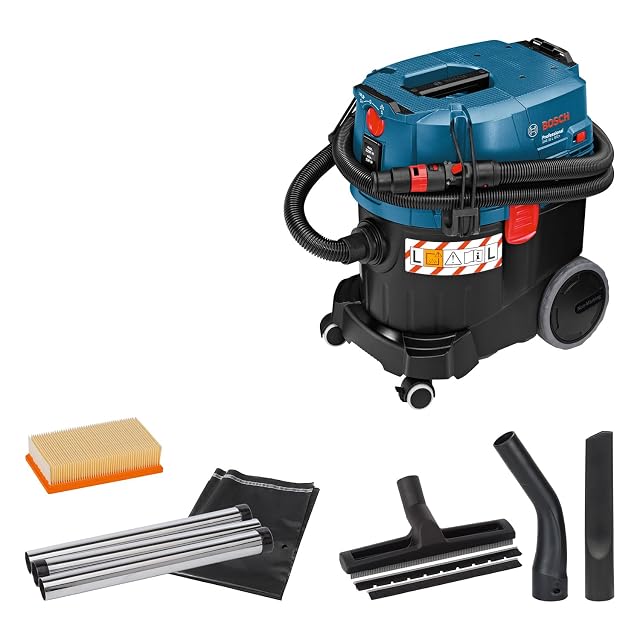
The published Bosch GAS 35 L SFC+ on the European half of this shelf is bought
for precisely that, and its page says so in a line. The published Metabo there
has the automatic version.
This is the only machine on this half with either.
Six and a half horsepower
About four thousand eight hundred watts.
A 120 volt 15 amp circuit supplies about one thousand eight hundred.
Peak air-watt ratings taken at stall have been the convention in shop vacuum
marketing for decades. That does not make them a power output, and the machine
draws what the socket gives.
What would describe it is the airflow, in CFM or cubic meters an hour. This page
publishes none.
The fraction you cannot see
Chips on the floor are a nuisance. The dust that matters is the part that never
lands.
Wood dust is classified as a Group 1 carcinogen by the IARC, and the particles
that reach the deep lung are below about ten microns — which is to say, invisible
in a shaft of sunlight through a workshop window.
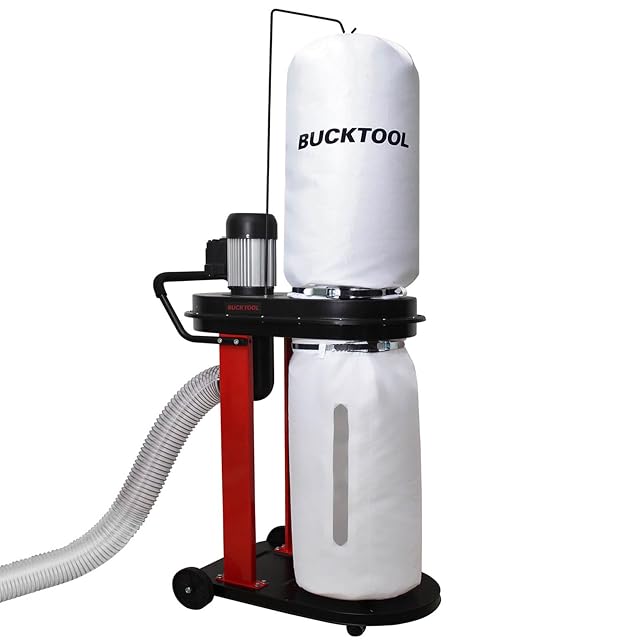
So the number that decides what a collector is worth is not its airflow. It is
what its filter stops. A machine that moves a great deal of air through a coarse
bag is a machine that measures the room’s dust and puts it back.
HEPA is a medium, not a machine
Ninety-nine point nine five per cent of particles at three tenths of a micron —
through the filter.
What it does not describe is the machine around the filter: the seals, the
housing joints, the exhaust. A HEPA cartridge in a leaky body is worse than a
class M machine with a coarser medium, because the class is measured at the
outlet of the whole thing.
The European half of this shelf is judged on that letter. The American half
publishes microns and media.
Nothing on either half publishes both.
An anti-static hose
The only one on this shelf, and not a marketing line.
Fine dust moving down a plastic hose builds a charge, and the charge jumps to
whatever is earthed — usually a hand on a machine. It is unpleasant rather than
dangerous at this scale, and in a shop with fine airborne dust it is the thing
nobody wants a spark near.
The published extraction-fittings shelf in this catalog compares static
earthing as one of its criteria. This is the only machine here that addresses it.
Ten things in the box
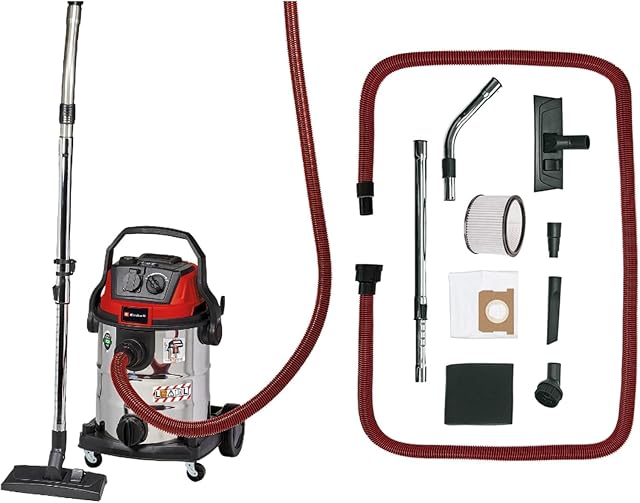
Hose, two wands, floor nozzle, universal adapter, crevice nozzle, round brush,
three filter bags, a HEPA filter, a utility nozzle, a foam filter.
A listing that enumerates its accessories rather than saying “accessories
included” is doing the reader a service, and three listings on this shelf do it.
The foam filter is the wet-pickup one, and with the drain port it is the half of
this machine that is a vacuum rather than an extractor.
Availability
Read on the day this page was built: $128 at the American Amazon shop.
Read from Keepa on the day this page was last revised; stock and price both move without notice.
Prices quoted in this text were read on 2026-10-07. The live price is at the top of the page.