HSS · 8 tools · HRC 56-63
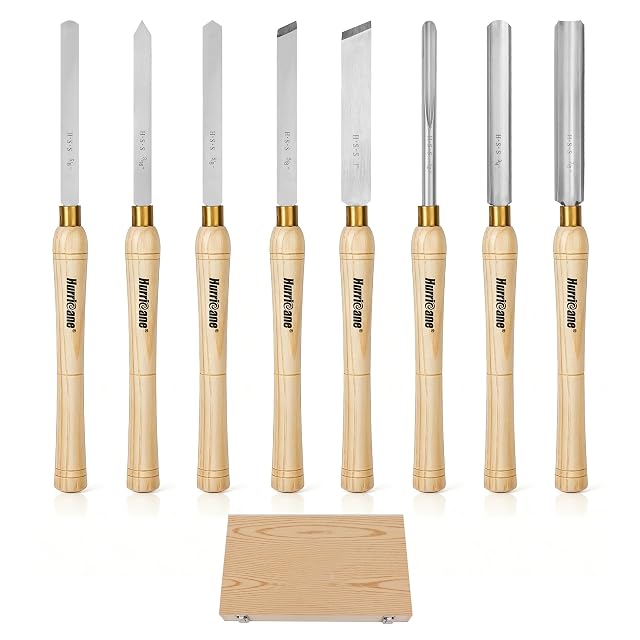
HURRICANE 02-170, 8-piece M2 HSS set
The only hardness figure on either half of this shelf that belongs to its own scale — 56 to 63 HRC, for high-speed steel.
Every figure below names its source. Each one is a manufacturer
specification read off the listing itself. The judgments are ours.
Fifty-six to sixty-three
A hardness range, published, on the Rockwell C scale — which is the right scale
for hardened steel.
Fifty-six is soft for a turning tool. Sixty-three is good. Seven points of
spread across eight tools suggests a specification band rather than eight
measurements.
The VEVOR carbide set on this shelf publishes 80 to 90 Rockwell. Carbide is
measured on the A scale, where it reads 88 to 93; the C scale stops near 70.
Two hardness figures on this shelf. One of them is on a scale that exists for the
material.
A 1/2 inch bowl gouge, a 7/8 roughing gouge, a 3/4 spindle gouge, a 1 inch and a
5/8 skew, a 3/16 parting tool, a 5/8 scraper.
That is close to the conventional starting set, and naming it is the useful part.
The roughing gouge takes a blank round; the spindle gouge shapes beads and coves;
the bowl gouge hollows; the skew planes; the parting tool separates; the scraper
cleans up where the grain fights back.
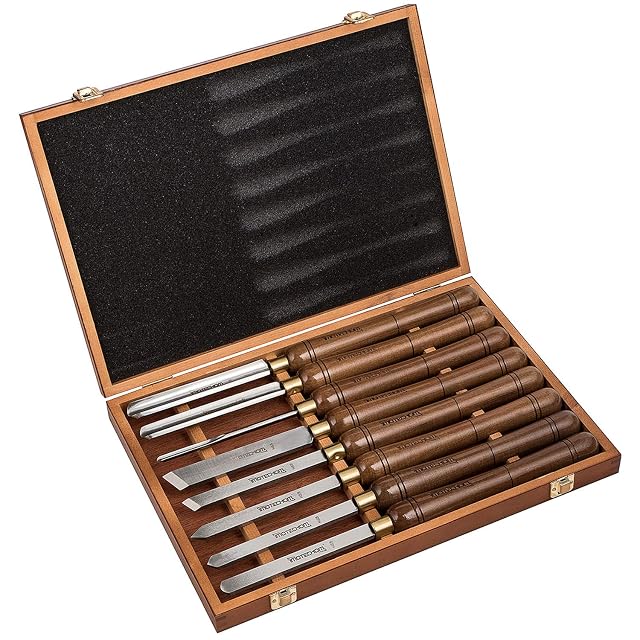
Two skews is one more than most beginners need. The published Holzstar eight-piece
set on this shelf covers the same ground and does not list its contents.
Brass ferrules
The joint where a cheap turning tool fails.
The tang is driven into a hole in the handle, and the wood around it is wedged
apart every time the tool takes a catch. Without a ferrule the handle splits, at
the worst possible moment.
A brass ring compresses the wood around the tang and holds it.
The published bowl gouge on this shelf is credited for a long handle giving
leverage against a catch. A ferrule is what lets the handle survive one.
Two schools, and they are not the same hobby
A traditional turning tool is ground steel on a long handle. It is presented to
the wood at an angle so the bevel rubs and the edge slices, which leaves a
surface that needs almost no sanding — and it has to be sharpened, which means a
grinder, a jig and a skill.
A carbide tool is a square or round plate screwed to a bar. It is held flat and
scrapes. It never needs grinding: when an edge dulls, the plate is rotated to the
next corner and eventually replaced.
The published pages on this shelf put both sides of it. The carbide set’s page:
removes the grinder and the sharpening jig from a beginner’s shopping list — and
carbide scrapes where a gouge slices, so the surface off the tool needs more
sanding. That is the whole choice.
Availability
Read on the day this page was built: $71 at the American Amazon shop.
Read from Keepa on the day this page was last revised; stock and price both move without notice.
Prices quoted in this text were read on 2026-10-07. The live price is at the top of the page.