Every figure below names its source. Each one is a manufacturer
specification read off the listing itself. The judgments are ours.
Ten inches of steel at three thousand four hundred and fifty
The only impeller published on either half of this shelf.
A ten-inch impeller at 3,450 rpm has a tip speed near ninety miles an hour, and
the volume it moves follows from the diameter and the speed together. Steel
rather than cast aluminum also says what happens the day a screw goes through
the port.
Thirteen listings on this shelf. One gives either figure.
It is also the one claim on this page that cannot be inflated, because the
geometry is fixed.
Two inlets
Two four-inch ports, stated to take two tools at a time.
That is the difference between a collector and a collector plus a trolley: a
table saw and a planer both stay connected, and the blast gate decides which one
is live rather than which hose is on.
Nothing else on either half of this shelf publishes a second inlet. Whether
two inlets is the same thing as two machines depends on the duct, not the
machine.
The fraction you cannot see
Chips on the floor are a nuisance. The dust that matters is the part that never
lands.
Wood dust is classified as a Group 1 carcinogen by the IARC, and the particles
that reach the deep lung are below about ten microns — which is to say, invisible
in a shaft of sunlight through a workshop window.
So the number that decides what a collector is worth is not its airflow. It is
what its filter stops. A machine that moves a great deal of air through a coarse
bag is a machine that measures the room’s dust and puts it back.
And this one stops at five microns
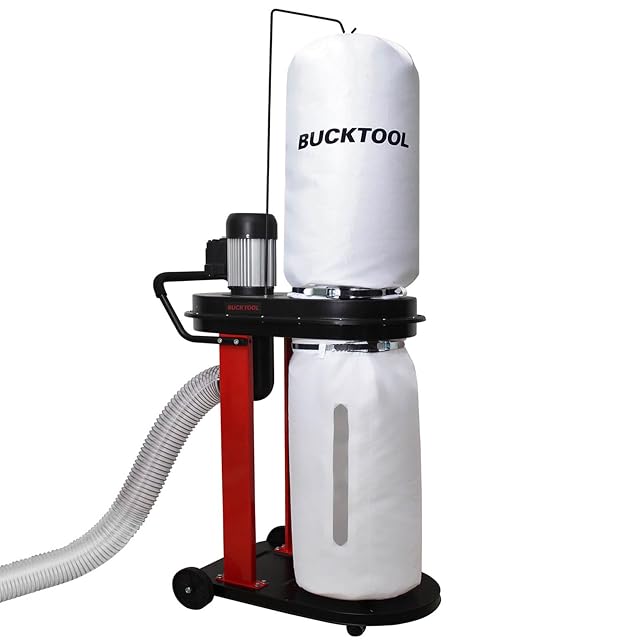
Better than the thirty-micron bag on the Rockler here. Worse than the
two-micron upper bag on the Bucktool.
Five microns catches everything larger and passes everything smaller, and the
fraction that reaches the deep lung is below about ten. So a five-micron bag
returns a real part of the harmful dust to the room it just collected it from.
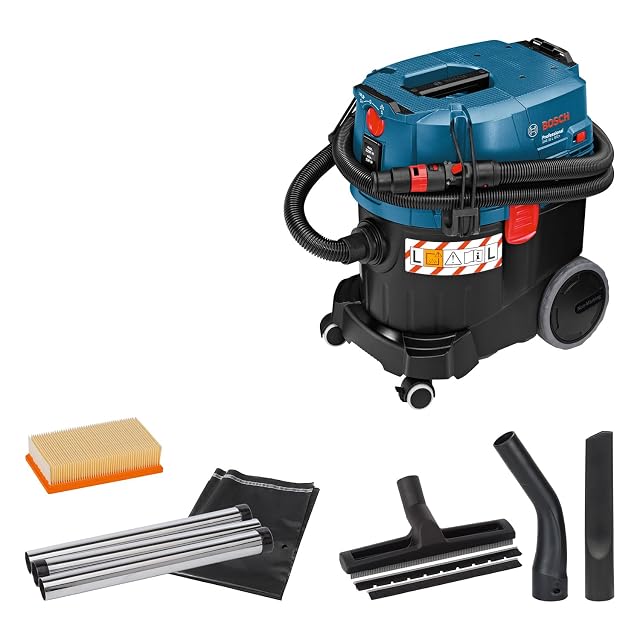
The European half of this shelf answers the same question with a letter: a class
M machine returns about ten times less fine dust than a class L. No machine on
either half publishes both.
Fourteen amps
The largest motor on this shelf, and a figure to read before buying.
Fourteen amps at 115 volts is a circuit most garages have exactly one of, and
running a table saw on the same one is how a breaker is found.
The maker publishes no wattage and no horsepower, which on this shelf is the
honest position — the Bucktool here publishes 6.5 A and 1.2 HP, and those two do
not agree.
Availability
Read on the day this page was built: $392 at the American Amazon shop.
Read from Keepa on the day this page was last revised; stock and price both move without notice.
Prices quoted in this text were read on 2026-10-07. The live price is at the top of the page.