Every figure below names its source. Each one is a manufacturer
specification read off the listing itself. The judgments are ours.
Thirty microns
The coarsest filtration rating on either half of this shelf, and it is what
comes in the box.
The fraction you cannot see
Chips on the floor are a nuisance. The dust that matters is the part that never
lands.
Wood dust is classified as a Group 1 carcinogen by the IARC, and the particles
that reach the deep lung are below about ten microns — which is to say, invisible
in a shaft of sunlight through a workshop window.
So the number that decides what a collector is worth is not its airflow. It is
what its filter stops. A machine that moves a great deal of air through a coarse
bag is a machine that measures the room’s dust and puts it back.
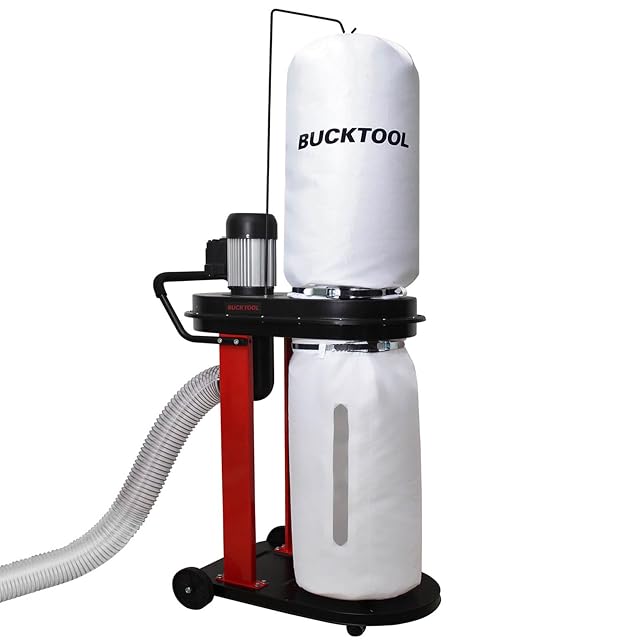
So this machine, as supplied, is a chip collector
It catches the mess and passes the hazard.
The published Scheppach DC500 page on the European half of this shelf puts it in
one line about the same kind of filter: chip collectors with bag filters return
fine dust to the room.
What this listing does, to its credit, is name the fix in the same bullet as the
problem: a one-micron canister, as an upgrade, sold separately.
That is the purchase. The bag is packaging.
One micron against thirty
Roughly the difference between catching what can be seen and catching what is
breathed.
A pleated canister also holds its airflow far longer than a bag, because the
cake of dust spreads over a much larger surface before it starts to choke.
The listing does not price it on this page. Budgeting for it is the honest way
to read the machine.
Keyhole slots
Wall mounted, with a Z-bracket in the box, and no casters at all.
In a shop short of floor that is the whole argument, and it is a different
proposition from the WEN DC3474 on this shelf, which is mobile with an optional
mount.
Permanent mounting also means ducting rather than dragging, and ducting is where
the airflow goes — which makes the missing port size more awkward than it looks.
Six hundred and fifty CFM, and nothing else
No amperage. No wattage. No horsepower. No impeller. No capacity. No port size.
No part number.
One figure on the page, and airflow without a port size is hard to use: the same
fan through a 2-1/2 inch hose and through a 4 inch duct are two different
machines.
Both WEN collectors here publish amps, an impeller and a bag rating. The
Bucktool publishes amps, horsepower, a bag rating and an outlet limit.
Availability
Read on the day this page was built: $440 at the American Amazon shop.
Read from Keepa on the day this page was last revised; stock and price both move without notice.
Prices quoted in this text were read on 2026-10-07. The live price is at the top of the page.