Every figure below names its source. Each one is a manufacturer
specification read off the listing itself. The judgments are ours.
Two hundred and fifty, plus two hundred
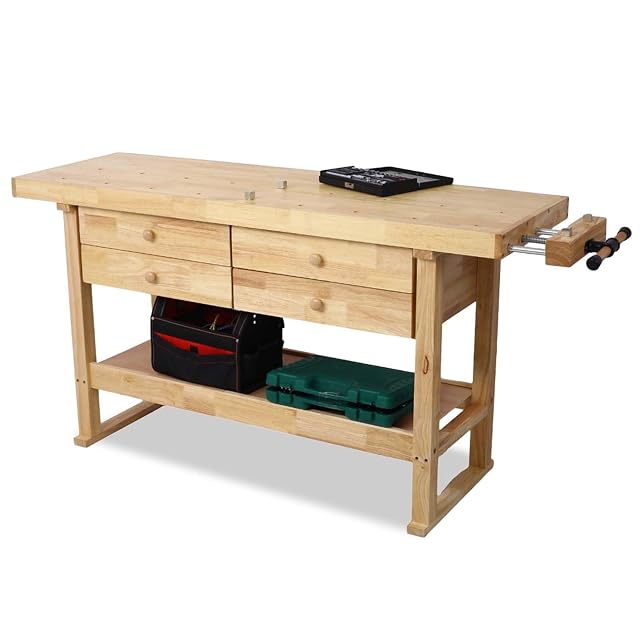
The title: Heavy-Duty 450 lbs Capacity.
The second feature: heavy-duty top supports 250 lbs, bottom shelf supports 200
lbs.
Those add to exactly four hundred and fifty.
So no part of this bench carries 450 pounds, and a reader who put 400 on the top
on the strength of the title would be at a hundred and sixty per cent of the
published figure for that surface.
Both statements are above.
The published Keter table on this shelf has the same family of fault in its cons —
450 kg (992.1 lb) in the title and 453 in the features — and that one is three kilograms
apart rather than a sum.
Sixteen dog holes
The only count on either half of this shelf, and the shelf’s own intro asks for
it: the practical question of how many ways a bench lets you clamp a board.
A dog hole takes a peg, a holdfast or a planing stop, and a board pushed against
two pegs is held by the push itself — the oldest work-holding arrangement there
is, and still the fastest.
Sixteen is an array. Four pegs in metal and four in wood come with it, which is
two different hardnesses for two different jobs: metal holds, wood does not mark.
Seven inches of vice capacity
Published, and the published Bosch PWB 600 page on this shelf names exactly this
as the figure a bench page needs: no clamping capacity, which is a bench’s only
real specification.
What is not published is whether a vice is included. The listing says vise slot
and 7 in capacity, which reads as a prepared mounting rather than a fitted
vice.
Mass, rigidity, racking
A bench is judged on three things and only one of them is usually published.
Mass is what stops the bench moving when a plane is pushed along a board. Rigidity
is what stops the top flexing under a mallet. Racking is the sideways parallelogram
collapse that every four-legged frame wants to do, and it is resisted by stretchers
and by the top being bolted down rather than resting.
A load rating is not any of the three — it says what the bench will hold standing
still. The published Bosch PWB 600 page on this shelf names the figure that
actually matters and its absence: no clamping capacity, which is a bench’s only
real specification.
And rubberwood dents
The timber of the rubber tree, after it stops yielding latex: pale, fairly light,
stable when kiln-dried, cheap, and it glues well.
Which is why half the bench tops in the world are made of it.
What it does is mark. It is softer than beech, so a dropped chisel dents it and a
hammer blow cups it. On a garage bench that is cosmetic.
The published Sjöbergs bench on this shelf is what beech buys instead, and its
page says what that is for: hand tool work, and any workshop where the bench is
the primary tool.
Availability
Read on the day this page was built: $287 at the American Amazon shop.
Read from Keepa on the day this page was last revised; stock and price both move without notice.
Prices quoted in this text were read on 2026-10-07. The live price is at the top of the page.