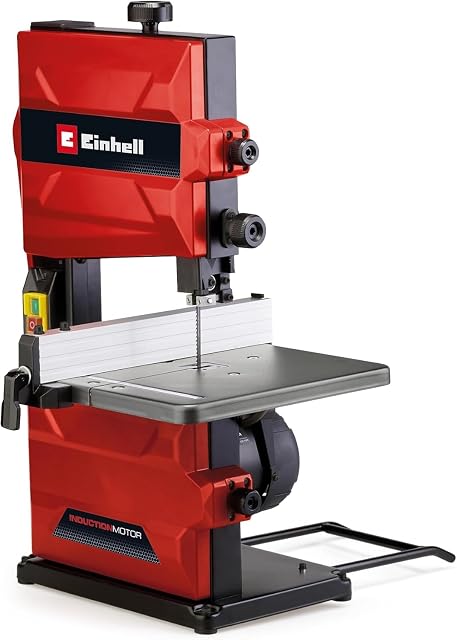
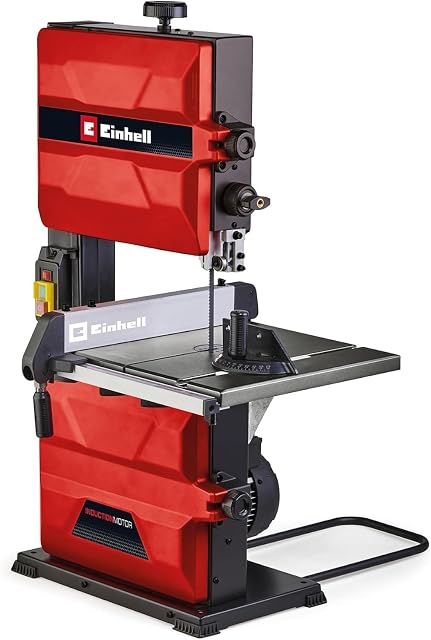
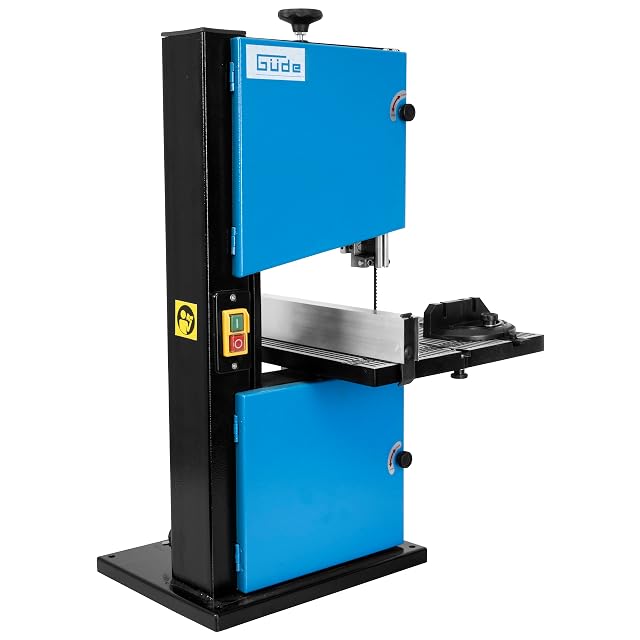
The end of it The right kind of machine on the wrong kind of listing. Get the two capacities in writing, then buy it in Germany.
Every figure is a manufacturer specification, read off the
listing itself, and the judgments are ours — drawn from how the
specification behaves in this class of machine and from what long-term
owners consistently report. Where a figure is missing, we say so rather
than fill it in.
What the specification says
900 W maintenance-free induction motor with restart protection, two cutting
speeds, balanced rubber-coated wheels, tool-free height adjustment of the blade
guard, tilting table for angled cuts, an LED work light, a quick-release
tensioning lever and a tool-free door for blade changes. The box holds the stand,
an A6 universal blade, a rip fence, a mitre fence, extraction adapters in Ø 44,
58 and 100 mm (3.94 in), a dust box and a push stick. Part number 619010000.
The specification is good and incomplete
Everything above describes how the saw is built, and it is built the way a
machine you keep for twenty years is built. None of it describes what the saw
can cut. Throat depth and resaw height are absent, and those are the two figures
a bandsaw is chosen on.
The three extraction adapters are worth a line of their own: Ø 100 mm (3.94 in) is chip
extractor territory, Ø 44 mm (1.73 in) is workshop vacuum territory, and supplying both
ends of that range is unusually thoughtful for the class.
Volume and suction are two different machines
Workshop dust equipment divides in two, and the division is not about
price. A chip extractor moves a large volume of air at low pressure
through a wide hose: that is what a planer, a bandsaw or a table saw
needs, because those machines produce shavings faster than a narrow hose
can carry them. A workshop vacuum moves a small volume at high pressure
through a narrow hose: that is what a sander, a router or a track saw
needs, where the waste is fine and the port is small.
Swap them and both fail in a predictable way. The vacuum blocks on the
first handful of shavings, and the extractor develops almost no suction
at a small port — leaving the fine fraction in the air, which is the
part that matters for your lungs.
The good side, and the catch
Strengths
Induction motor rather than a universal one — quieter, and it lasts
Restart protection, so it cannot come back on by itself after a power cut
Balanced rubber-tyred wheels and two speeds, for timber and for metal
Stand, fences, dust box and push stick all in the box
Compromises
Neither throat depth nor maximum cut height is published
No. The listing carries part number 619010000 and reads BAS 318 Precision DNB. The number in a Metabo bandsaw name refers to the wheel size, so the two machines are not close — we review the one that exists at this reference.
Which two numbers is the listing missing?
Throat depth, which is the distance from the blade to the frame and therefore the widest board you can cut a curve in, and maximum cut height, which is the thickest piece you can resaw. Together they are the bandsaw. Ask before ordering; Metabo publishes both in its own documentation.
Why does an induction motor matter here?
A bandsaw runs continuously through long cuts rather than in bursts. Induction motors are heavier and quieter, they hold speed under load, and they have no brushes to replace — which is why almost every stationary machine worth keeping uses one and almost every hand tool does not.
Where this model is listed
A listing is not an offer: the reference exists on these stores, availability changes daily.
France
Germany
Italy
Spain
United Kingdom
United States
Our score
8.9/ 10
The right kind of machine on the wrong kind of listing. Get the two capacities in writing, then buy it in Germany.
Who buys this one, among woodworking machines
A settled workshop that wants one quiet machine for curves and resawing
Sources
Specifications: the manufacturer sheet for woodworking machines and the matching Amazon product page. Prices and availability: Keepa. Every figure on this page names its source.