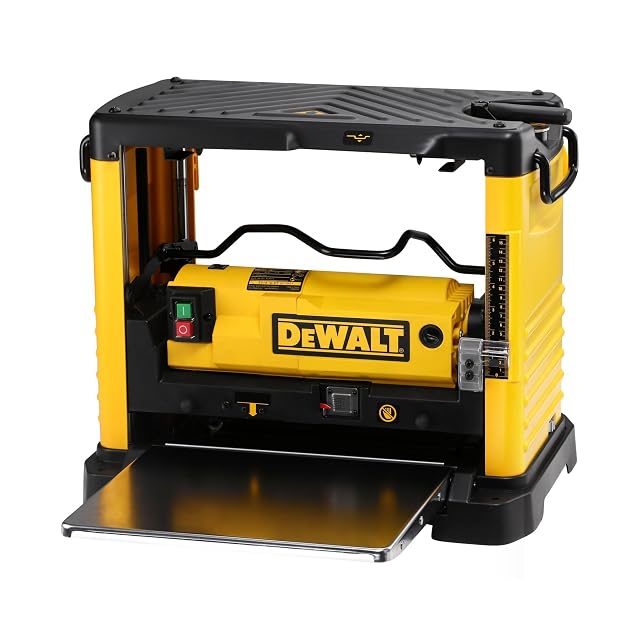
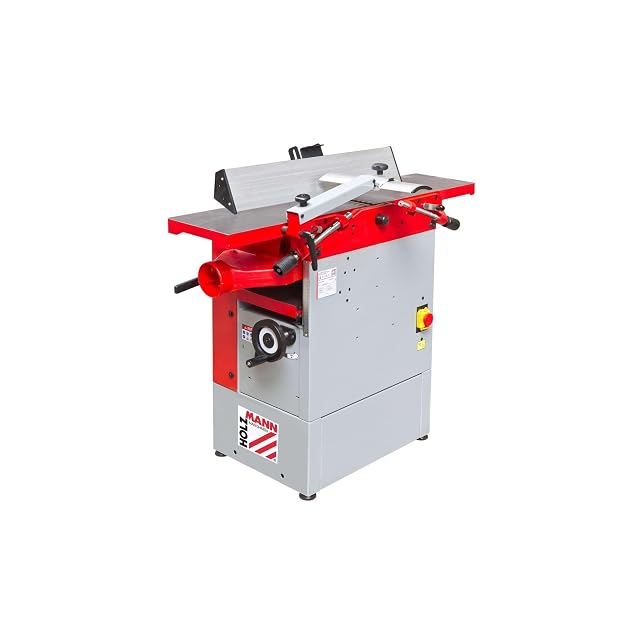
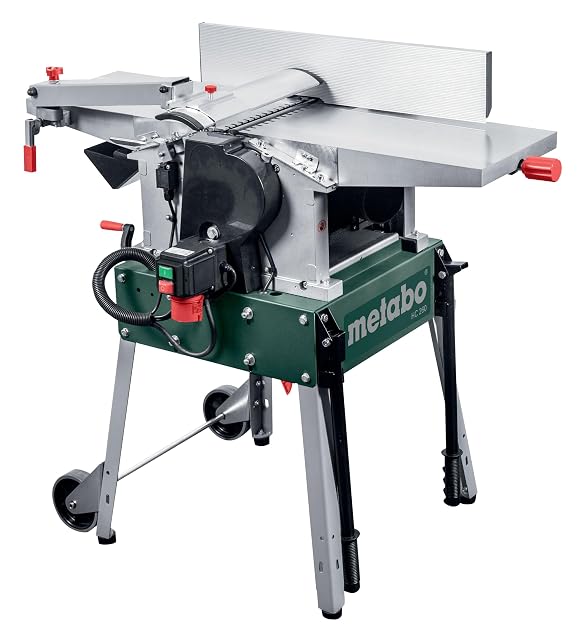
The only planer here that publishes how much it takes off in one pass — 3 mm (0.12 in) surfacing, 2 mm (0.08 in) thicknessing — and the most evenly priced across Europe.
The end of it Narrower than the Scheppach and more honest about its limits. Even pricing across Europe means you can just buy it locally.
Every figure is a manufacturer specification, read off the
listing itself, and the judgments are ours — drawn from how the
specification behaves in this class of machine and from what long-term
owners consistently report. Where a figure is missing, we say so rather
than fill it in.
What the specification says
1,500 W, a combined surfacing and thicknessing machine, 204 mm (8.03 in) planing width,
120 mm (4.72 in) thicknessing height, maximum removal of 3 mm (0.12 in) when surfacing and 2 mm (0.08 in) when
thicknessing, a solid aluminum surfacing table, two knives, an extendable
outfeed support, a Ø 100 mm (3.94 in) extraction port, vibration-damping feet, a no-volt
switch and thermal overload protection. Part number 4419952.
The depth-of-cut figures are the point
Every planer at this price takes a shallow cut. Almost none of them say how
shallow. Publishing 3 mm (0.12 in) and 2 mm (0.08 in) tells you directly how many passes a 25 mm (0.98 in)
reduction will take, which is the practical question when you are standing in
front of a stack of rough boards deciding whether the machine is worth the
afternoon.
Snipe, and why every planer has it
Snipe is the shallow dip a thicknesser cuts at the start and the end of
a board — a few hundredths of a millimeter, over the last hundred
millimeters or so. It happens because the board is held by two rollers
in the middle of the cut and by only one at each end, so it lifts
fractionally into the cutter.
No thicknesser in this price range eliminates it. The ones that manage
it best have longer tables, adjustable rollers, or a head lock. The
practical answer is the same on all of them: feed a sacrificial board
nose-to-tail with the real one, or cut your stock 150 mm (5.91 in) over-length and trim
the ends afterwards.
Width is the compromise
204 mm (8.03 in) against the Scheppach’s 254 mm (10 in) is 50 mm (1.97 in) of board. That sounds small and
it decides what the machine is for: rails, stiles, battens and small beams, yes;
a glued panel or a wide shelf, no. Width cannot be added afterwards, and it is
the single specification most owners of a narrow planer eventually regret.
The good side, and the catch
Strengths
States its depth of cut in both modes, which nothing else in this group does
No-volt release and thermal overload protection as standard
Extendable outfeed support, which helps with long boards
Compromises
204 mm (8.03 in) of width is the narrowest of the seven planers here
Aluminum tables rather than cast iron
Two straight knives, with the tear-out that implies
Not sold on amazon.com
Specifications
Motor
1,500 W
Planing width
204 mm (8.03 in)
Thicknessing height
120 mm (4.72 in)
Maximum removal
3 mm (0.12 in) surfacing, 2 mm (0.08 in) thicknessing
Surfacing table
Aluminum
Extraction port
Ø 100 mm (3.94 in)
Part number
4419952
Amazon reference
B0D93Y8Y2F (identical on 5 markets)
EAN
4006825679144
What comes up most often
Is 3 mm (0.12 in) a lot to take in one pass?
On a 1,500 W machine at full width, it is the maximum rather than the working figure — a 3 mm (0.12 in) cut across 204 mm (8.03 in) of hardwood will make the motor work and the finish will be rougher than a light pass. Its value is that it is published: you know where the ceiling is instead of finding it.
Aluminum or cast iron tables?
Cast iron is flatter over time and damps vibration better; aluminum is lighter and cheaper and can twist. On a machine of this size and price the aluminum table is the expected compromise, and it is worth checking flatness with a straightedge when it arrives.
What does the no-volt release do?
It stops the machine restarting on its own when power returns after a cut. On a planer, with a cutterhead spinning and a board possibly still in the throat, that is not a luxury feature.
Where this model is listed
A listing is not an offer: the reference exists on these stores, availability changes daily.
France
Germany
Italy
Spain
United Kingdom
Our score
7.5/ 10
Narrower than the Scheppach and more honest about its limits. Even pricing across Europe means you can just buy it locally.
Who buys this one, among woodworking machines
Smaller stock — battens, rails, small beams — where 204 mm (8.03 in) is enough
Sources
Specifications: the manufacturer sheet for woodworking machines and the matching Amazon product page. Prices and availability: Keepa. Every figure on this page names its source.